Practical, room-by-room strategies for a cleaner life
Dr. Rigobert Kefferputz, ND
Naturopathic Doctor • Salt Spring Island, BC
Hi, I'm glad you're here.
Toxic load is the cumulative burden of chemicals your body absorbs every day
from food, water, air, and the products you use. There are over
80,000 synthetic chemicals registered for use in North
America, and most have never been tested for long-term safety in humans.
Your body is designed to detoxify – your liver, kidneys, skin, and lungs work
around the clock. But when the incoming load exceeds your capacity to process
it, symptoms appear. This guide gives you five practical areas you can
address today – no appointment needed.
How to use this guide: Don't try everything at once. Pick one
section, focus on it for two weeks, then add the next. Swap products as they
run out. Small, consistent changes beat dramatic overhauls every time.
1
Clean Up Your Kitchen
Your kitchen is the single highest-impact room to address. Most of these
swaps are one-time changes that pay off for years – and patients often
notice less bloating, clearer skin, and more energy within weeks.
"If you could only change one room, make it the kitchen."
Ditch plastic food containersPlastics leach endocrine-disrupting chemicals like BPA and phthalates,
especially when heated. Switch to glass or stainless steel for storage and
reheating. A one-time cost of $20–30 that lasts for years.
Filter your drinking waterMunicipal water can contain chlorine, fluoride, heavy metals, and
pharmaceutical residues. A basic carbon filter pitcher or faucet attachment
removes the most common contaminants. Around $30 and replacement filters
last months.
Swap non-stick cookware for cast iron or stainless steelNon-stick coatings (PTFE/PFOA) release toxic fumes when overheated and
degrade into your food over time. Cast iron is inexpensive, naturally
non-stick when seasoned, and adds beneficial iron to your meals.
Choose organic for the Dirty DozenYou don't need to buy everything organic. Focus on the EWG's "Dirty
Dozen" – the twelve fruits and vegetables with the highest pesticide
residues (strawberries, spinach, apples, grapes, etc.). The "Clean Fifteen"
are safe to buy conventional.
Quick win: Start with water and food storage. Filtering your
water and switching to glass containers takes one afternoon and removes two of
the biggest daily sources of chemical exposure in most households.
2
Detox Your Personal Care
The average person uses 9–12 personal care products each morning,
exposing themselves to over 120 unique chemicals. Your skin is your largest
organ – what goes on it goes in.
Switch to fragrance-free productsThe word "fragrance" on a label can hide dozens of undisclosed chemicals,
including xenoestrogens and neurotoxins. Choosing "fragrance-free" (not
"unscented," which may still contain masking agents) is the single
biggest step you can take.
Check ingredients with EWG's Skin Deep databaseBefore buying a product, look it up at ewg.org/skindeep. It rates
products on a simple 1–10 toxicity scale. Aim for products rated
1–3. This free tool takes the guesswork out of label reading.
Switch to natural deodorant and mineral sunscreenConventional antiperspirants contain aluminum, and chemical sunscreens
(oxybenzone, octinoxate) are absorbed into your bloodstream within hours.
Mineral sunscreens with zinc oxide sit on the skin and are far safer.
Swap products as they run outYou don't need to throw everything away at once. Each time a product
runs out, replace it with a cleaner alternative. Within 3–6 months,
your entire routine will be transformed – without the overwhelm or
the expense.
A pattern I see often: Patients with persistent hormonal acne,
eczema, or unexplained rashes improve significantly just by cleaning up their
personal care products – before we change anything else in their treatment plan.
3
Improve Your Home Air
2–5x
Indoor air is typically 2–5 times more polluted than outdoor
air – and we spend roughly 90% of our time indoors. The good news:
improving your air quality is mostly free.
Open windows for 15+ minutes dailyCross-ventilation is the simplest way to flush out indoor pollutants.
Even in winter, a brief opening dramatically improves air quality.
Ditch synthetic air fresheners and scented candlesPlug-ins, sprays, and paraffin candles release VOCs and phthalates.
If you enjoy scent, use beeswax candles or a diffuser with pure essential oils.
Use a HEPA filter in your bedroomYou spend 7–9 hours breathing bedroom air every night. A portable
HEPA purifier captures dust, mold spores, and fine particulates.
Remove shoes at the doorShoes track in lead dust, pesticides, and contaminants. A no-shoes
policy combined with HEPA-filter vacuuming dramatically reduces exposure.
Bonus: Add houseplants – spider plants, pothos, and snake
plants absorb formaldehyde and benzene. They won't replace ventilation,
but they help.
4
Open Your Emunctories
Reducing what comes in is only half the equation. Your body also needs
to move toxins out. In naturopathic medicine, we call the organs of
elimination emunctories – your bowels, kidneys, skin, lungs,
and liver. Think of them as exit doors. If those doors are sluggish, toxins
recirculate and accumulate no matter how clean your environment is.
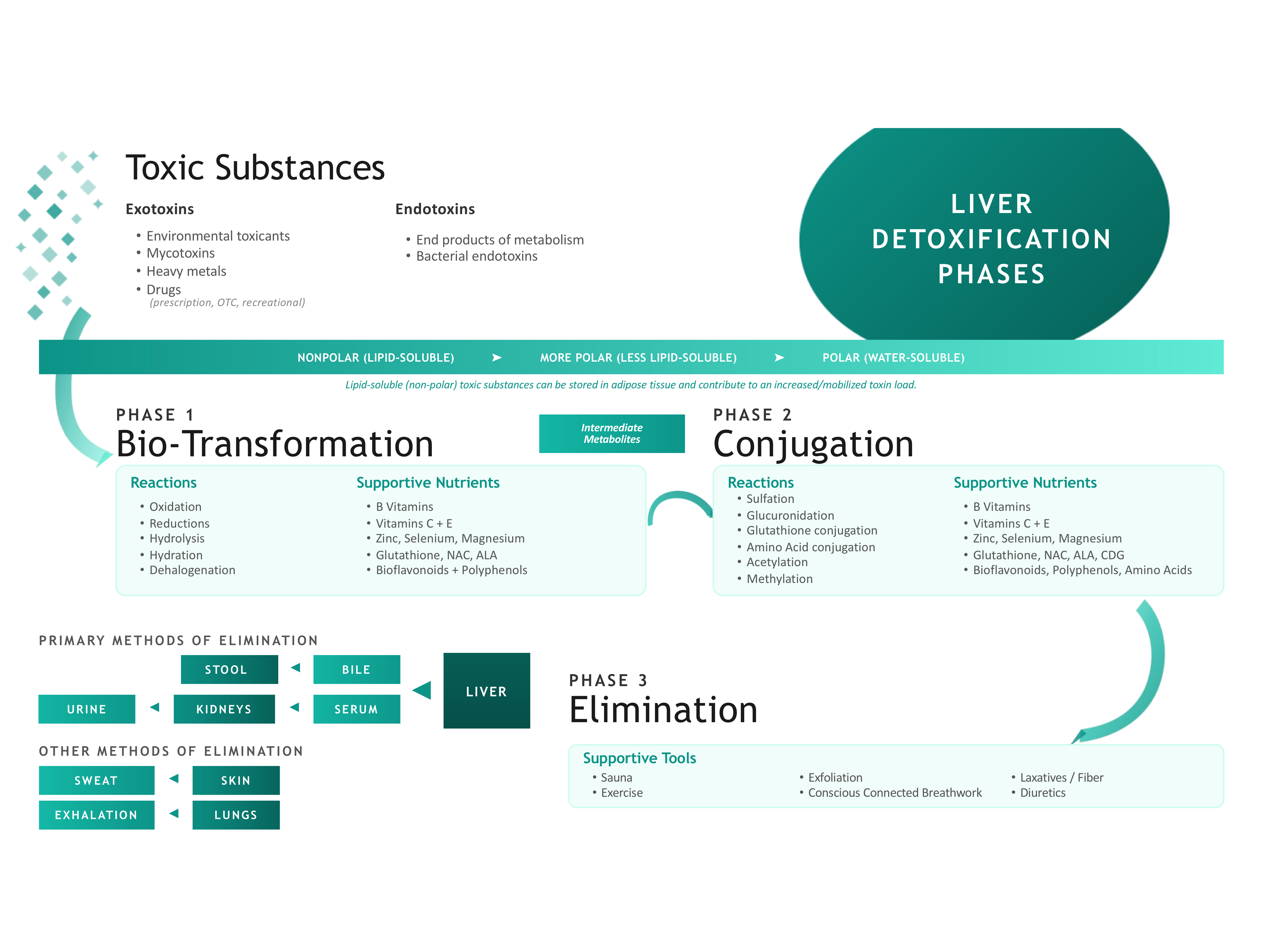
How your body processes and eliminates toxins through three phases of detoxification
Your liver transforms toxins through Phase I and Phase II before they can be
eliminated through your primary emunctories – stool, urine, bile – and
secondary pathways like sweat and the skin. Both the detox phases and the
elimination routes need to be well supported.
Eat cruciferous vegetables and bitter foods dailyBroccoli, kale, cauliflower, and cabbage contain sulforaphane and
indole-3-carbinol, which directly fuel Phase I and II liver detoxification.
Bitter foods like arugula, dandelion greens, and warm lemon water stimulate
bile flow – how your liver actually moves processed toxins out.
Get adequate protein for Phase IIPhase II conjugation depends on amino acids like glycine, taurine,
and glutamine. Aim for a palm-sized portion of quality protein at every
meal – eggs, fish, legumes, or organic poultry. A well-fed liver
detoxifies far better than a starved one.
Prioritize daily bowel movementsYour bowels are the primary route for eliminating processed toxins.
Without at least one well-formed bowel movement daily, toxins get reabsorbed
back into circulation. Eat plenty of fibre (ground flaxseed, vegetables,
legumes), stay hydrated, and move your body.
Sweat intentionally and regularlySweating through exercise, sauna, or hot baths eliminates heavy metals
and persistent organic pollutants that the kidneys and bowels cannot clear
alone. Aim for 20–30 minutes of sweat-inducing activity 3–4
times per week. Infrared saunas are particularly effective.
Hydrate to support your kidneysYour kidneys filter roughly 200 litres of blood per day, excreting
water-soluble toxins through urine. Aim for half your body weight (in
pounds) in ounces of filtered water daily. Add a pinch of mineral salt
or lemon to improve absorption. If your urine is dark yellow, you're
behind.
Why this matters: I often see patients who eat perfectly and
live in clean environments but still feel unwell – because their emunctories
are sluggish. Opening these exit routes is one of the most overlooked steps
in reducing your toxic load.
5
Reduce Hidden Exposures
Some of the most significant exposures fly under the radar because they seem
harmless. Once you know where to look, they're easy to address – and most
cost nothing.
✓
Decline thermal paper receiptsCoated in BPA/BPS that absorbs through skin on contact. Ask for
email receipts. Never let children handle them.
✓
Check for lead and moldPre-1978 homes may have lead paint; older pipes can leach lead. If
you see or smell mold, address it – mycotoxins are a serious source of
chronic illness.
✓
Simplify your cleanersWhite vinegar, baking soda, and castile soap handle most household
cleaning. For disinfecting, use hydrogen peroxide. Simpler is safer.
✓
Reduce EMF exposureTurn Wi-Fi off at night, keep your phone out of the bedroom or on
airplane mode. Simple, free, and precautionary.
Total cost of these changes? Essentially zero. Awareness
is the most powerful detox tool you have.
When professional support makes sense
These five steps address the most common everyday exposures – but
some patients need deeper investigation. Consider working with a practitioner if:
Heavy metal testing – to identify accumulated lead, mercury, arsenic, or cadmium
Mold and mycotoxin panels – especially if you have chronic fatigue, brain fog, or respiratory issues in a damp environment
Organic acids testing – a urine test that reveals how well your detox pathways are actually functioning
IV chelation and glutathione therapy – clinical-grade support when the body needs help clearing what it can't process on its own
Testing reveals what no amount of guesswork can – the specific burden
on your body and the most effective path forward. That's where
personalized care begins.
Ready for personalized detox support?
I offer comprehensive environmental health assessments, targeted testing,
and individualized detoxification protocols – in person on Salt Spring
Island or via telemedicine across British Columbia.
Dr. Rigobert Kefferputz, ND
13 years helping people who feel unheard and overwhelmed. I listen first, then build a plan around your life – not the other way around.